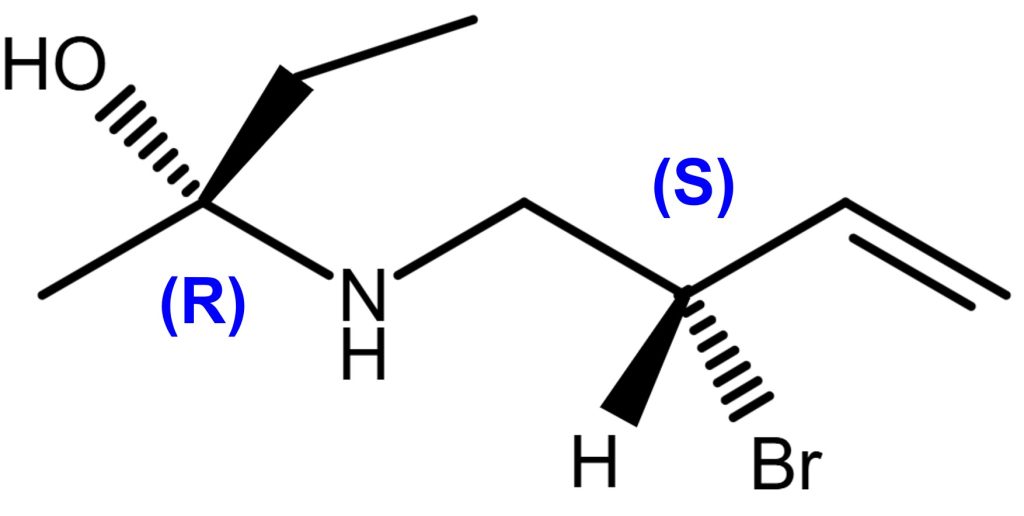
Cahn-Ingold-Prelog rules: Assignment of priorities of Chiral Center
- Identify the chiral center atom. If the atom is achiral, there is no R S Configuration or assignment.
- The priority is based on the atoms (first location) directly attached to the chiral center.
- The higher the atomic number, the higher the priority.
- If a double or triple bond, count that atom twice or three times, respectively.
- If there is a tie at the first location, compare 3 atoms (at the second location) attached to the tie atoms (first location).
- A greater number of higher-priority atoms has priority over a fewer number of higher-priority atoms (e.g., OOC > OCC).
- If the second location is still tie, move on to the next atom (third location), which is the highest atomic number (e.g., if the first locations have a tie that the same atoms are connected to ONC (at the second location), then follow the path of oxygen before nitrogen or carbon and compare the atom(s) connected to the oxygen). If still tie, continue this path and repeat the process until the tie is broken or the end of the line.
- If still tie, then move on to the next highest priority atom (at the second location). In the above example, move on to N and compare 3 atoms (at the third location) connected to nitrogen (at the second location) and continue this path until the tie is broken or the end of the line. If still tie, move on to the next highest priority atom (carbon in the above example) and repeat and compare.
R S Configuration Example
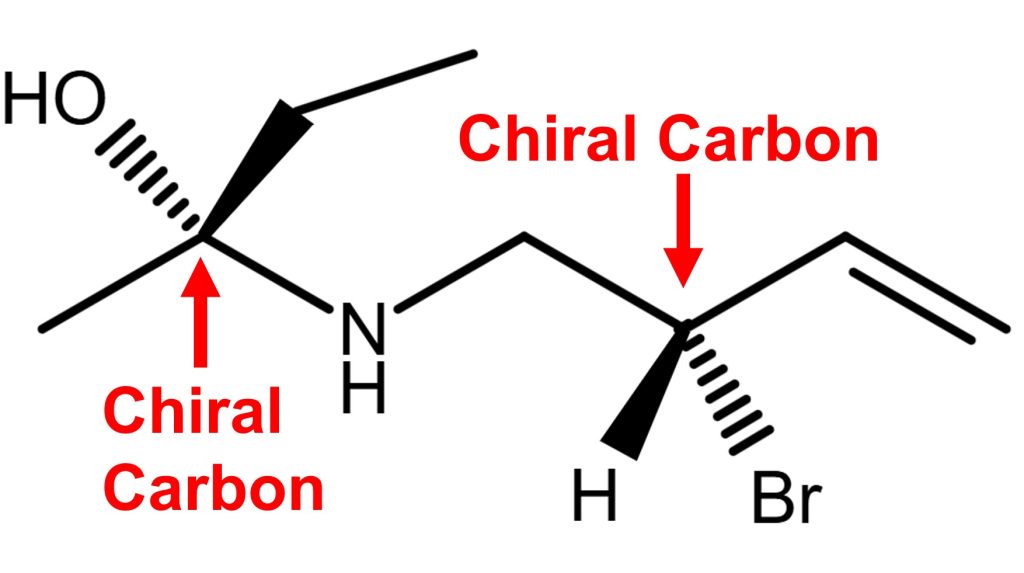
The chiral carbon on the right side.
There are 2 chiral carbons on this compound. Let’s start from the chiral carbon on the right side and apply priority rules.
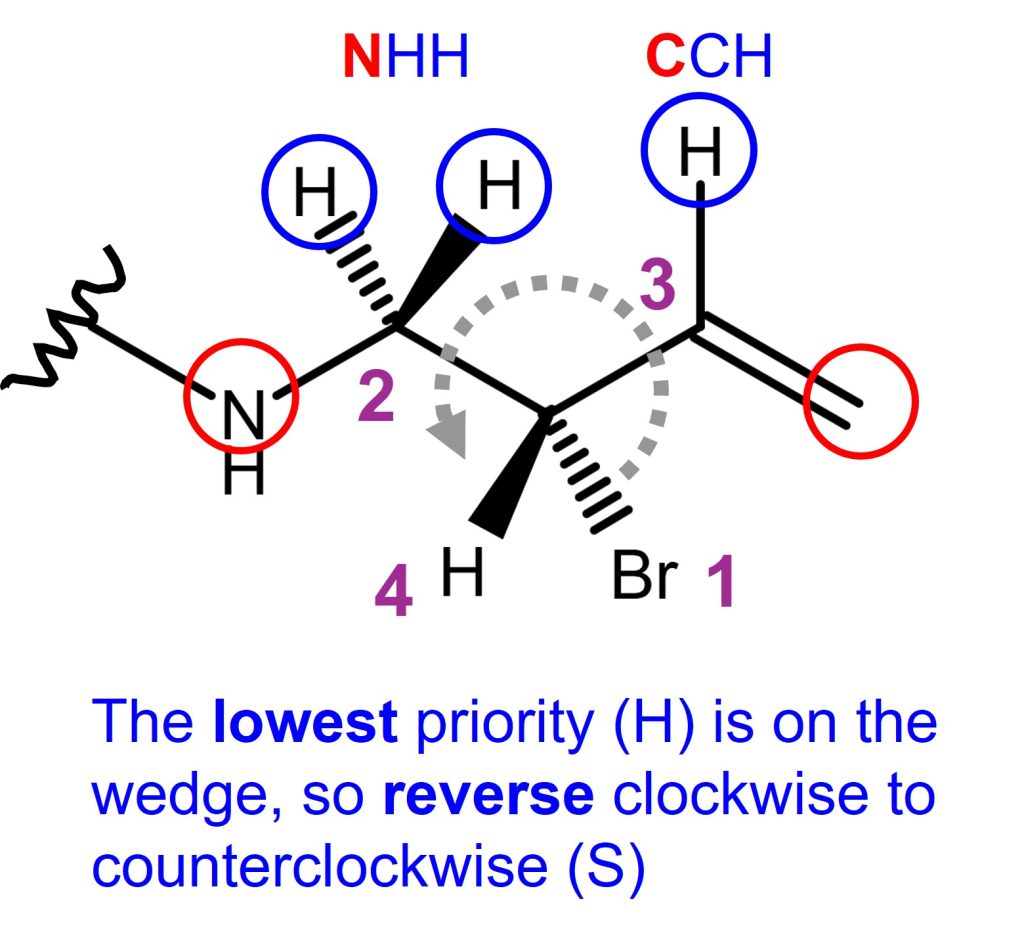
- Br is the highest atomic number, and hydrogen is the lowest atomic number. Therefore, they’re priority 1 and 4, respectively. There are two carbons on the left and right, and they are tie.
- Look at what each carbon is connected to. The carbon on the right is connected to C, C, H (double bond counts twice). The carbon on the left is connected to N, H, H.
- Nitrogen has a higher atomic number than carbon. Thus, the carbon on the left gets the higher priority (priority 2), and the carbon on the right is priority 3.
- This gives clockwise rotation; priority 1. Br, 2. C (right), 3. C (left), 4. H.
- Since the lowest priority atom (hydrogen) is on the wedge, reverse clockwise to counterclockwise rotation, which gives (S).
The chiral carbon on the left side
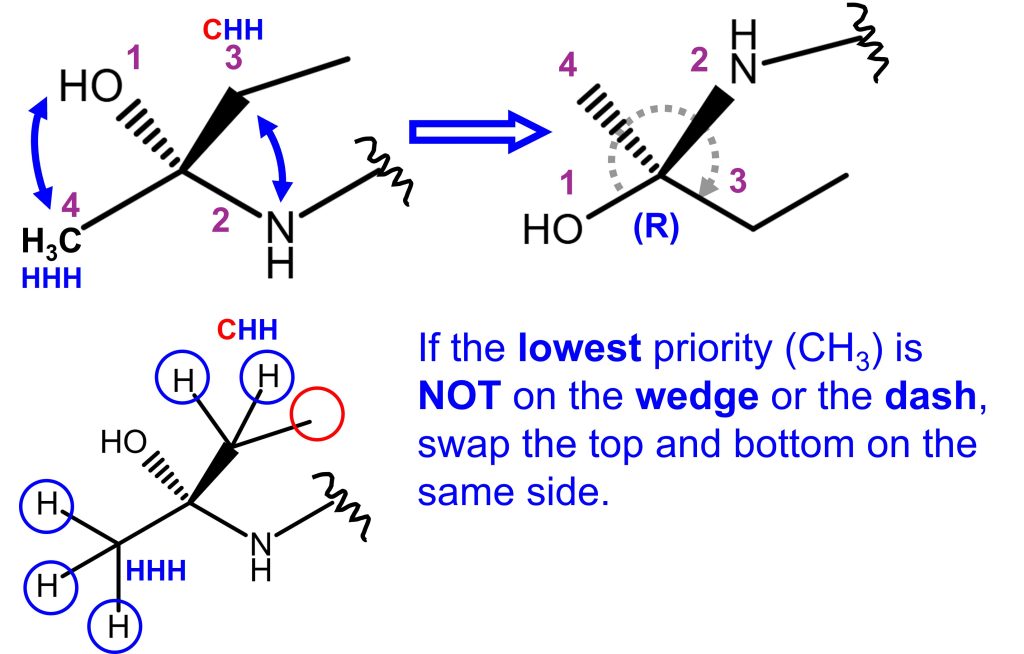
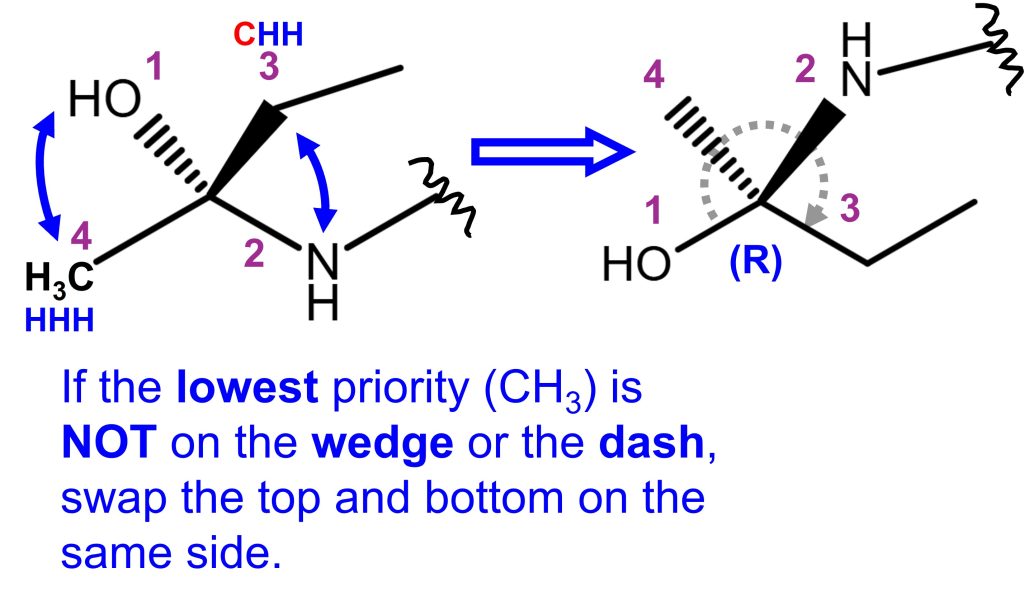
- O (OH) is the highest atomic number, and nitrogen is the second highest atomic number. Therefore, they’re priority is 1 and 2, respectively. There are two carbons on the wedge and the left, and they are tie.
- Look at what each carbon is connected to. The carbon on the wedge is connected to C, H, H. The carbon on the left is connected to H, H, H.
- Carbon has a higher atomic number than hydrogen. Thus, the carbon on the wedge gets the higher priority (priority 3), and the carbon on the left is priority 4.
- But the lowest priority (CH3) is not on wedge or dash. In this case, swap the top and bottom on each side.
- This gives clockwise rotation (R); priority 1. O, 2. N, 3. C (wedge), 4. C (left).